About me
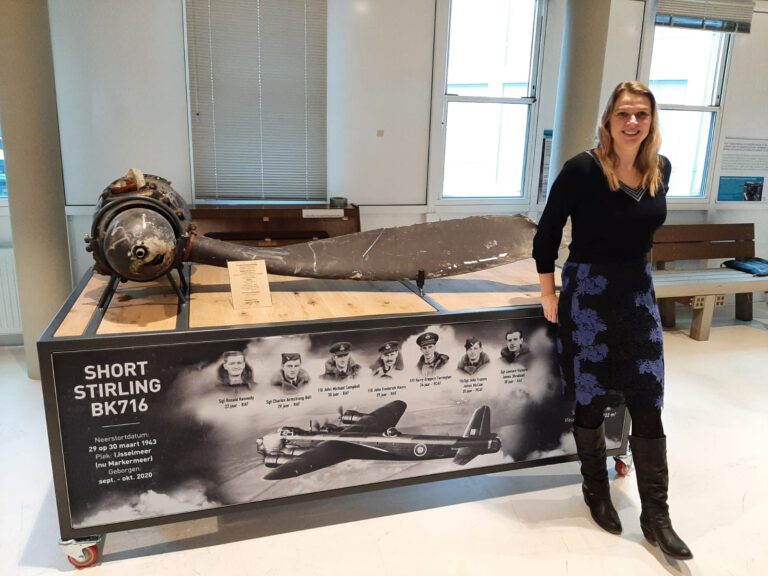
Hi, I’m Lilian van Mourik. I live and work in Almere, the Netherlands. For the past several years, I’ve been closely involved in the recovery of Second World War aircraft, including as project manager for the large-scale recovery of the Short Stirling BK716, which was found in Lake Markermeer and recovered in 2020.
During the Second World War, over 5,500 aircraft crashed in the Netherlands. More than 1,000 airmen are still missing, hidden in around 400 wrecks scattered across land, lakes, and sea. After the war, the Netherlands was rebuilt and life moved on. Yet for the families of these airmen, the loss remained unresolved. That is why, in 2019, the Dutch government established the National Programme for Aircraft Recovery: to fulfil the long-held wish of relatives to bury their loved ones and finally gain certainty about what happened to them. Research shows it is still technically possible to recover 30 to 50 aircraft, with a good chance of finding missing airmen.
BK716 was the third aircraft recovered under this programme. The aircraft crashed in 1943 during a mission, carrying seven crew members—five British and two Canadian. During the recovery, human remains were found. In 2021, a ceremony was held in Almere with the families, where the Rise monument was unveiled in honour of the crew. A year later, the men were buried with full military honours at Jonkerbos War Cemetery in Nijmegen.
Since then, I have remained involved in aircraft recovery work, not only as a project manager but also as an advisor to the National Programme for Aircraft Recovery. Being part of these recoveries has given me a deep respect for the responsibility that comes with bringing the past back to the surface.
Meeting the relatives has been one of the most meaningful parts of this work. The pain of not knowing what happened to a loved one, even after eighty years, is difficult to imagine. Being able to help provide answers and a place of remembrance for families has been a true honour.
The story of BK716 is much bigger than a single aircraft. It is about freedom, loss, and remembrance. These experiences made me increasingly aware of how closely history, landscape, and personal stories are connected—especially in the Dutch polders, where much of the land did not yet exist during the war.
That connection between landscape and memory led to the creation of Polder Pathways. Through this project, I bring my experience with aircraft recoveries and historical research together in small-scale WWII heritage tours, focusing on the human stories behind the events and the choices people were forced to make.
Alongside Polder Pathways, I continue to share stories through writing and media. I created the BK716’s E-Magazine together with international students, combining historical research, storytelling, and education. I also worked as an advisor and liaison with the British production company North One on Guy Martin’s Lost WW2 Bomber and appeared as a guest on The Unconventional Soldier podcast.
I also host Holland’s Hidden Heroes, a podcast for children and families, co-hosted by 11-year-old Colin, where history is explored through the eyes of younger generations.
Through all of this work, one thing has become clear to me: stories matter. They help us understand the past, connect with one another, and reflect on the freedom we enjoy today.
That is why I created Their Story, to share personal stories from Dutch history and from those who lived through war, loss, and rebuilding, and to ensure they are not forgotten. I hope these stories remind us all—young and old—that freedom must never be taken for granted.
Lilian van Mourik